CS2 Valve Regional Standings Explained: How VRS & Invites Work

The Valve Regional Standings (VRS) is the official rankings system for the Counter-Strike 2 (CS2) esports ecosystem. It’s Valve’s mammoth undertaking to create a fair system, with recent team performance at the forefront, serving as a sole factor for invites to Major Championships.
Since the system is such a critical component of the CS2 esports scene, we’ve decided to explain all aspects of the VRS, from how team points are calculated to Major invites, how you can check the rankings, regional quotas, and some FAQs to finish off the proceedings.

- 1. How Valve Regional Standings Work In CS2
- How Are VRS Points Calculated
- Rosters & Regional Assignments
- 2. How VRS Determines CS2 Major Invites
- 3. How Regional VRS Quotas For Majors Work
- 4. CS2 Tier 1 & Tier 2 Event Invites Difference
- 5. Where To Check Live Valve Rankings
- 6. Where Are The MRQs & RMR Systems?
- 7. VRS vs. CS Rating (Premier) - What's The Difference?
- 8. FAQs
- 9. References
How Valve Regional Standings Work In CS2
Instead of “closed” systems (e.g., Riot’s partnered teams), the VRS embraces an open esports ecosystem. Its primary goal is to create equal opportunities, where tournament invites depend solely on a team’s skill on the server and their ability to win matches, prioritizing LAN events.
The VRS is divided into Global, Europe, the Americas, and Asia leaderboards. It’s built on an Elo-style ranking model, where teams earn (or lose) points based on their performance at Valve-sanctioned events.
While there are many factors to determine VRS points, the following carry the most weight:
- A team’s prize money earned.
- Prize money earned by defeated opponents.
- Number of teams defeated.
- Head-to-head results.
There’s a heavy focus on recent matches for an accurate indication of current team form. With an Elo system in place, teams that play more matches against equally ranked opponents have a chance to earn more points and climb the VRS leaderboard more quickly.
How Are VRS Points Calculated
To determine a Final Rank Value, a Starting Rank Value plus Head to Head Adjustments are incorporated. Here’s the math behind deciding Team Vitality’s Final Rank Value of 1907.9 on November 3, 2025:
Final Rank Value (1907.9) = Starting Rank Value (1843.1) + Head To Head Adjustments (64.9)Starting Rank Value
To figure out a roster’s Starting Rank Value, first take the average of these four factors:
- Bounty Offered: 1.000
- Bounty Collected: 0.747
- Opponent Network: 0.431
- LAN Wins: 0.900
The average of these factors is 0.770. Next, take the maximum and minimum average across all teams and compute the following:
400 + ((Roster_Average - Min_Average) / (Max_Average - Min_Average)) * 1600 = 1843.1and
400 + ((0.770 - 0.000) / (0.853 - 0.000)) * 1600 = 1843.1If you want to explore the math in greater detail, check out Valve’s official explanation and insights for the example above.
Rosters & Regional Assignments
In 2025, each team is assigned to a single region to ensure there’s no overlap across multiple leaderboards. This placement is determined by where most of its players are based (e.g., if four out of five members are from Europe, the team will compete in the European circuit).
Valve has also issued strict roster requirements in the Supplemental Rulebook to create a fair ecosystem where roster hopping and other forms of manipulation are prohibited.
Note: To create a fair system based solely on performance, tournament operators are prohibited from having business relationships with teams on the VRS, and all rewards, including precise prize pool distributions, must be publicly disclosed.
How VRS Determines CS2 Major Invites
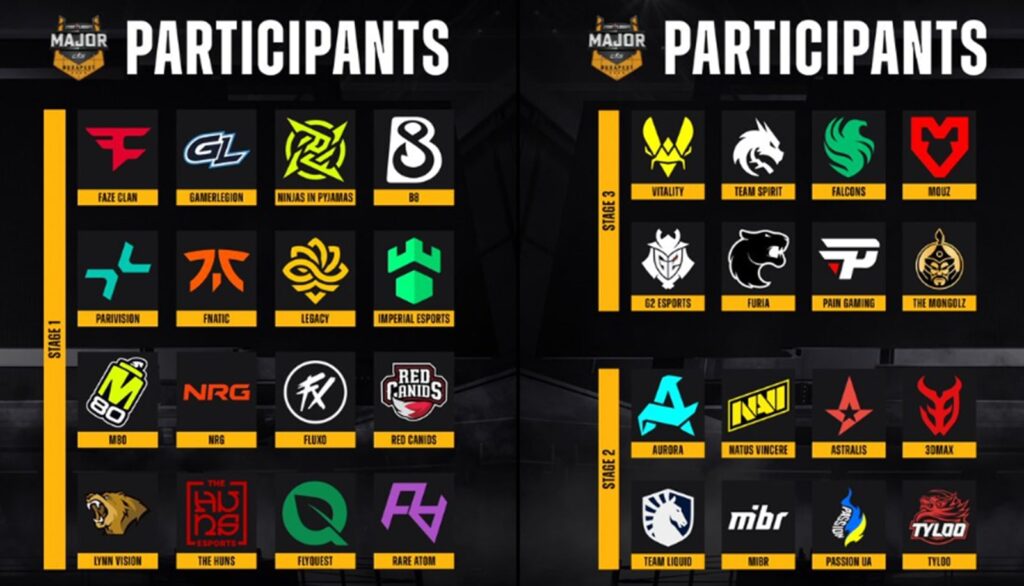
Starting with the StarLadder Budapest Major 2025, invites for each of the three Swiss stages of competition are based solely on VRS. For reference, at the BLAST.tv Austin Major, Stage 1 spots were still earned via regional qualification tournaments.
To claim one of the 32 Major Championship spots, teams must rank high enough in their respective region (Europe, Americas, or Asia) before a specific VRS invite cutoff date. For example, the StarLadder Budapest Major 2025 cutoff date was October 6.
The VRS isn’t perfect, and Valve has committed to making changes or experimenting as time goes by. A prime example of a flaw in the VRS is how many pro teams traveled nonstop to compete in smaller LAN events to earn last-minute VRS points before the StarLadder Budapest Major cutoff date.
How Regional VRS Quotas For Majors Work
Based on a region’s perceived strength and historic data, teams on the VRS earn spots in different stages of a Major Championship. For example, Europe is the strongest CS2 esports region, and therefore, has the most Stage 3 spots.
By contrast, the Americas (i.e., consolidation of South and North American areas) is considered the second-strongest, and Asia is the weakest. You can check out the regional VRS quotas for Major Championship invites for each stage outlined below.
| Region | Stage 1 | Stage 2 | Stage 3 |
|---|---|---|---|
| Europe | 6 | 5 | 5 |
| Americas | 6 | 2 | 2 |
| Asia | 4 | 1 | 1 |
| Totals | 16 | 8 | 8 |
So what about the Global version of the VRS? Well, once all teams accept invitations to a Major Championship, the Global VRS rankings are used to determine pre-event seedings for each stage of the tournament.
CS2 Tier 1 & Tier 2 Event Invites Difference
Most CS2 tournaments use the VRS system to determine direct team invites, and some mix in qualifier events. For example, the Thunderpick World Championship 2025 Finals used August 4 VRS rankings to assess the four direct invites, while the other four teams earned spots via a Closed Qualifier.
In turn, invites to the Regional Qualifiers that led to the Closed Qualifier were mainly based on VRS rankings. The Regional Qualifiers were considered Tier 2 events, while the TWC 2025 Finals LAN was considered a Tier 1 event.
That’s where the invite difference comes into play. The VRS creates a clear gap between Tier 1 and Tier 2 events. Invitations for Tier 1 events begin at the top of the VRS, while those to Tier 2 events start with the team placed ninth or below.
The clear, straightforward division between Tier 1 and Tier 2 events enables lower-ranked teams to shine in Tier 2, climbing the leaderboard in their respective region.
Where To Check Live Valve Rankings
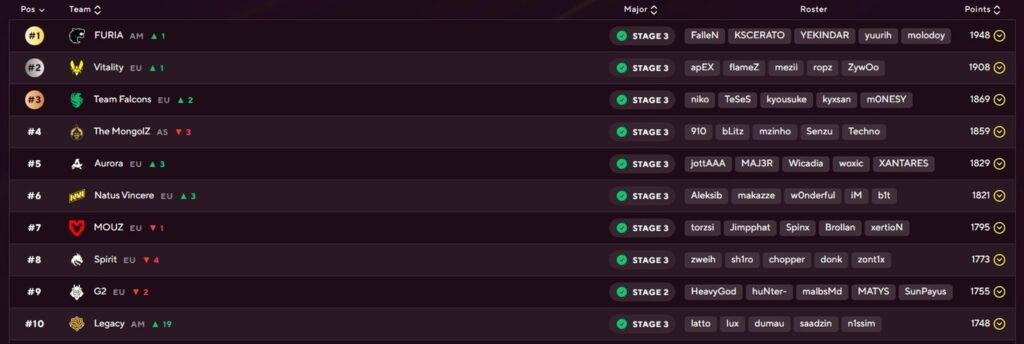
You can check the VRS via tournament organizer BLAST.tv’s official Valve Rankings page.
While Valve publishes all-important ranking updates on the first Monday of every month, the aforementioned Valve Rankings page also features a Live VRS that updates daily with point changes based on Valve’s Live data.
We recommend checking the VRS after every significant LAN event to see if there are changes in global or regional rankings. If you want to explore the data behind Valve’s rankings on BLAST.tv for yourself, be sure to check out the official public GitHub repository.
Where Are The MRQs & RMR Systems?
The Valve CS2 ranking system completely replaced the Major Regional Qualifiers (MRQs) and the Regional Major Rankings (RMR), which were prevalent in the CS:GO era (since 2020) and during the first few CS2 Majors.
The MRQs were events that determined which teams earned spots in the Majors before the Major Championship rulebook update. If anyone says MRQs still take place, their information is outdated.
VRS vs. CS Rating (Premier) – What’s The Difference?
CS Rating and the VRS are both based on the Elo system. That’s where the similarities end. The VRS, as we’ve explained in detail, is Valve’s Regional Standings, which determine rankings of teams in the CS2 esports ecosystem. CS Rating, on the other hand, is the system by which CS2 players climb the Premier Mode leaderboard. You can learn more in our dedicated guide to CS2 Ranks, including Competitive and Premier Mode details.
FAQs
What are the Valve Regional Standings in CS2?
The VRS is Valve’s ranking system. It places a heavy focus on a team’s recent performance and ability to win against opponents of similar rank.
Which regions does VRS cover?
The VRS comprises three broad regions: Europe, the Americas, and Asia.
Do LANs count more than online tournaments?
Yes. Matches played on LAN carry significantly more weight than those played online.
How often are the VRS updated?
The VRS gets official, significant updates on the first Monday of each month. However, points are updated via Live data frequently, nearly daily.
What is the difference between VRS and HLTV rankings?
The VRS decides Major invites and qualification to top events, using recent results and prize money as key factors. HLTV updates weekly, ranking teams based on LAN results and opponent strength.
References
- Roster Details (GitHub)
- The CS Major Supplemental Rulebook (GitHub)
- Valve Rankings (Blast)
- ValveSoftware/counter-strike_regional_standings (GitHub)
- Regional Standings (Github)