What Is ACS In VALORANT? Meaning, Calculation & Scores Explained

If you want to know which player had the most significant impact in a VALORANT map or match, the easiest solution is to look at the Average Combat Score (ACS). The stat represents a holistic view of player performance, considering multiple factors to assess overall impact in combat.
Let’s dig in and comprehensively discuss what ACS in VALORANT is, including its meaning, how the stat is calculated, factors that affect your score, tips to improve, and some common questions to finish off proceedings.

- 1. What Does ACS Mean in VALORANT? Explained
- Combat Score vs. ACS — What’s The Difference?
- 2. How Is ACS Calculated In VALORANT?
- 3. What Increases Combat Score In VALORANT?
- #1 Damage
- #2 Kills
- #3 Multikills
- #4 Non-Damaging Assists
- ACS Example In VALORANT
- 4. What Is A Good ACS In VALORANT?
- ACS Expectations By Role (Duelist vs. Initiator vs. Sentinel vs. Controller)
- 5. Does ACS Affect Rank In VALORANT?
- ACS Misconceptions & Common Myths
- 6. How To Improve Your ACS In VALORANT - Top Tips
- 7. Limitations Of ACS As A Performance Metric
- 8. FAQs
What Does ACS Mean in VALORANT? Explained
ACS in VALORANT goes beyond scoring kills, offering a holistic view of a player’s impact on a map. The acronym stands for Average Combat Score. It’s the ultimate representation of player contributions across all rounds, based on the stats available on the in-game scoreboard.
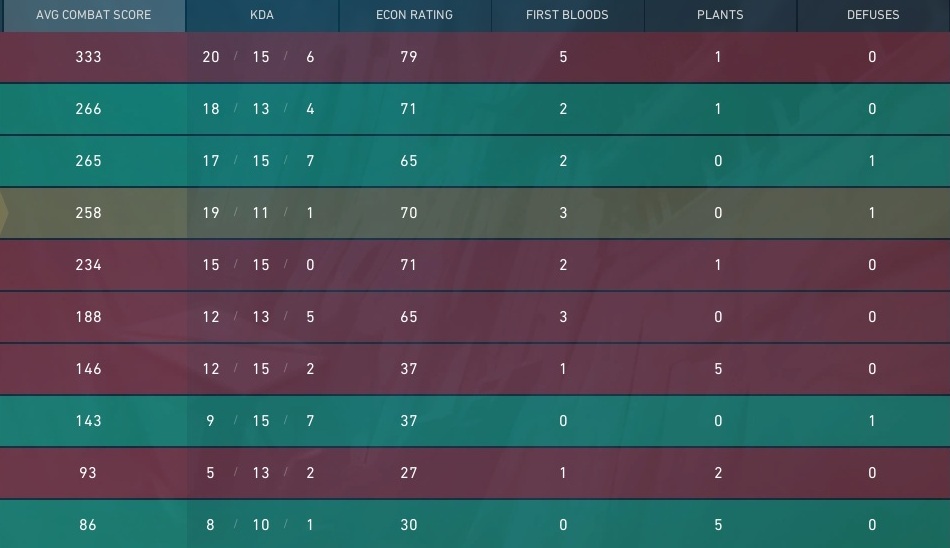
Riot Games displays the ACS score right next to players’ names on the VALORANT scoreboard. ACS is in the first column of stats, indicating its value.
Combat Score vs. ACS — What’s The Difference?
Combat Score is a raw number representing a player’s combat impact per round, while ACS is the per-round average per map, or an entire match.
While this might seem simple, it’s important that gamers fully understand the fundamental (yet critical) distinction:
Combat Score can become artificially inflated. For example, if a player earns 150 Combat Score per round, after 10 rounds, that’s 1500. The “1500” number might seem incredible, but when the ACS calculation is done, you’re left with 150—below average.
To better understand this, you need to know how ACS is calculated in VALORANT.
How Is ACS Calculated In VALORANT?
The ACS calculation formula in VALORANT is the sum of Combat Score earned across a map, divided by the total number of rounds played.
The formula used to calculate ACS per map is:
Map ACS = Total Combat Score ÷ Total Number of Rounds Played
The in-game calculation is always rounded to the nearest whole number, so an ACS of 144.6 is 145, and an ACS of 144.4 is 144.
For a best-of-three and best-of-five match, the calculation simply indicates the average of all maps played. For example, in a best-of-three that went the distance, a player scores 200 on Sunset, 300 on Breeze, and 150 on Haven.
The calculation for the match ACS is as follows:
Match ACS = (Map 1 ACS + Map 2 ACS + Map 3 ACS) ÷ Number of Maps Played
In the scenario above, that’s 217 = (200 + 300 + 150) ÷ 3. While the math behind calculating ACS in VALORANT is pretty easy, understanding precisely what increases your Combat Score becomes a bit trickier.
What Increases Combat Score In VALORANT?
Four actions can increase your Combat Score in VALORANT. These factors have different values: three are combat-specific, and one action that does not necessarily deal any direct damage.
We’ve outlined the actions that can increase Combat Score in a match of VALORANT below.
#1 Damage
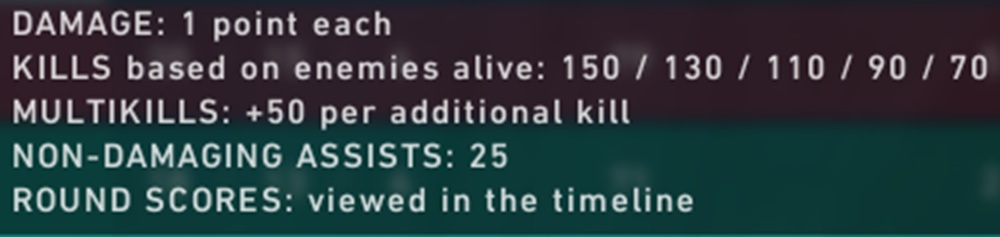
Dealing damage increases your Combat Score. One point of damage adds one point of Combat Score to your tally for a round. For example, if you deal 69 damage in a round, you get 69 Combat Score.
#2 Kills
Taking down enemies is one of the best ways to increase your Combat Score. The Combat Score per kill depends on how many enemies are alive at the time of a kill. If all five were alive, you get 150; if four were alive, you get 130; if three were alive, you get 110; if two were alive, you get 90, and if you kill the final enemy, you get 70.
#3 Multikills
On top of the Combat Score earned from kills, you get an extra 50 per additional kill in a round. A total of two kills per round nets you 50 extra, three kills is 100 extra, and four kills is 150.
#4 Non-Damaging Assists
You earn 25 points when assisting your teammate in getting a kill, without doing any damage. For example, if you heal your teammate with Skye’s Regrowth ability before they get a kill, you’ll earn 25 Combat Score. Actions such as buffing your teammates with Brimstone’s Stim Beacon or detecting enemies with Sova’s Recon Dart all count towards assists if an enemy is taken down promptly.
You can view individual round scores in the timeline tab of the scoreboard.
ACS Example In VALORANT
Let’s discuss a fictional example of how ACS over five rounds could play out with Sage.
- Round 1: Sage deals 80 damage to an enemy without getting the kill.
- Round 2: Sage gets the first two kills (150 + 130 + 50), and her Slow Orb slows two enemies that are later killed by her teammates (25 + 25).
- Round 3: Sage uses Healing Orb to heal her Duelist teammate, who swings around a corner and subsequently gets a triple kill (25 +25 + 25). Sage kills the final enemy (70), dealing 50 damage.
- Round 4: Sage deals 20 damage to an enemy without getting the kill, then an enemy gets impaired by Slow Orb and gets killed by her teammates (25)
- Round 5: Sage dies first without using an ability or dealing any damage.
In the scenario above, Sage has the following Combat Scores per round.
- Round 1 = 80
- Round 2 = 380
- Round 3 = 195
- Round 4 = 45
- Round 5 = 0
That means the Total Combat Score ÷ Total Number of Rounds Played would play out like this: (80 + 380 + 195 + 45 + 0) ÷ 5 = 140.
Fortunately, VALORANT does the calculations for you—but it’s good to know precisely why your ACS looks good, or bad.
What Is A Good ACS In VALORANT?
You’ll find ACS ranges and map/match impact comments outlined in the table below. These estimates vary based on factors such as winning or losing a map, the average player skill level, the chosen Agents, and the maps played.
| VALORANT ACS Ranges | Map/Match Impact |
|---|---|
| 50-100 | Poor |
| 100-150 | Below average |
| 150-200 | Average |
| 200-250 | Above average |
| 250-300 | Strong |
| 300 or more | Exceptional (MVP-level) |
ACS Expectations By Role (Duelist vs. Initiator vs. Sentinel vs. Controller)
We’ve established that the ACS range of 150-200 is considered “average” performance. However, ACS expectations can also fluctuate based on a player’s role in VALORANT.
Duelists, for example, Jett and Raze, are expected to score more kills (and possibly multikills), while Initiators could open up a round, scoring more first kills than others.
Damage-dealing ability is one of the primary factors to earn good ACS, as per our explanation of actions that increase Combat Score. With that in mind, review the “average” ACS expectations by role outlined below.
- Sentinel – 140 to 190
- Controller – 150 to 200
- Duelist – 165 to 215
- Initiator – 155 to 205
Note: The numbers above are not set in stone and can shift with balance updates. These are average expectations, but don’t feel bad if you don’t regularly hit or exceed the ACS values.
Does ACS Affect Rank In VALORANT?
ACS is a stats system that rewards players for consistent combat performance. In VALORANT’s Competitive game mode, the higher your ACS, the faster you will climb through the ranks.
Players earn more Ranked Rating (RR) if their ACS is high when they win a match, and lose less RR. You can review the scenarios with examples of RR gain/loss based on your ACS:
- High ACS and match win – Highest RR gain (e.g., +25 to +35)
- High ACS and match loss – Lose less RR (e.g., -10 to -12)
- Low ACS and match win – Gain less RR (e.g., +10 to +15)
- Low ACS and match loss – Highest RR loss (e.g., -25 to -35)
The better your combat performance, the less RR you’ll lose if you lose a match, and vice versa.
ACS Misconceptions & Common Myths
Having said that, there are a few misconceptions and myths about ACS in VALORANT that we would like to dispel.
First off, completing non-combat objectives such as defusing the Spike won’t net you any extra Combat Score points, despite what some players might think.
The biggest myth, however, is that some players believe ACS affects the hidden matchmaking rating (MMR) linked to your profile. This is simply not true, as ACS has no bearing on a player’s MMR.
After scoring a high ACS in a match, you won’t suddenly get matched with much higher-ranked players.
How To Improve Your ACS In VALORANT – Top Tips
To improve your Combat Score and, therefore, your ACS in competitive VALORANT, we’ve outlined a few top tips:
Hone Your Aim: The best way to improve your Combat Score is to hit more shots, thereby dealing additional damage and possibly scoring kills or multikills. Practice your aiming on the competitive maps.
Map Positioning: Another way to secure more kills or deal heaps of damage is to find good positioning on every competitive VALORANT map. Learn the correct crosshair placements and pre-aiming stances for high-activity areas, such as chokepoints or Spike sites, to gain an advantage.
Utility Usage: Pick a handful of Agents to practice with in your preferred role, and learn the ins and outs of their ability kits. Efficient utility usage, including non-damaging abilities such as a Recon Dart or a non-lethal grenade, can lead to 25 Combat Score assists. In a team fight, you can earn up to 125 Combat Score with perfect utility usage.
Communication: Always maintain communication with your team. For example, call out that you can heal your Duelist before they jump back into a fight to score some non-damaging assists.
Teamwork: Above all else, prioritize teamwork. Execute plays on Spike sites in unison for a better shot at dealing damage or scoring kills. Link up with a teammate and swing on an enemy at the same time, overwhelming them to score a kill, some damage, or at the very least, an assist.
Limitations Of ACS As A Performance Metric
ACS offers a solid view of a player’s combat performance in a match. It’s holistic and a fantastic indicator of impact. However, there are a few limitations. ACS does not consider non-combat actions, including the following:
- Sacrifice: If a player sacrifices themselves for the good of a team, for example, running around a corner to draw enemy fire, and they don’t deal damage or earn non-damaging ability assists, ACS does not count this contribution.
- An IGL’s Impact: ACS does not account for an in-game leader (IGL)’s strategic prowess, calling out tactics and positioning.
- Objectives: You don’t earn ACS for planting or defusing the Spike, which is a highly impactful play.
- Economy Rating: The in-game economy rating system does not count towards your total Combat Score.
FAQs
What Does ACS Mean In VALORANT?
ACS stands for Average Combat Score. It’s a holistic approach to measuring combat performance.
How Is ACS Calculated In VALORANT?
The following VALORANT ACS calculation formula is used: ACS = Total Combat Score ÷ Total Number of Rounds Played.
What Is A Good ACS Score In VALORANT?
A good ACS score ranges between 200 and 300.
Does ACS Affect MMR In VALORANT?
No. ACS does not affect your MMR in VALORANT. It does, however, affect the amount of RR lost or gained at the end of a competitive map, which impacts your climb through the in-game ranks.
How Can You Improve Your ACS In VALORANT?
The best ways to improve your ACS in VALORANT are to hone your aiming and movement skills on competitive maps, while at all times assisting your teammates.
Does ACS Impact MVP Awards?
Yes. ACS is the sole determining factor. The person with the highest ACS at the end of a competitive VALORANT match is crowned the Match MVP.