Dota 2 Ranks Explained (2025): Complete MMR & Ranking System Guide

The Dota 2 ranking system ensures fair ranked games while tracking your skill growth and overall progression. But with medals, matchmaking rating, Rank Confidence, and Immortal Draft, it can all feel confusing. So how do players read these signals and turn them into steady MMR gains?
This guide clears the fog by mapping all the Dota 2 ranks and estimated MMR ranges, explaining Rank Confidence and the Glicko system in plain terms, and demystifying calibration. We’ll also break down the Dota 2 rank distribution and offer some practical tips to help you climb.

- 1. What Are Dota 2 Ranks And MMR?
- All Dota 2 Ranks And Tiers
- Dota 2 MMR Rank Ranges
- 2. How Does The Dota 2 Ranking System Work In 2025?
- Rank Confidence
- Calibration
- 3. How To Check Your MMR In Dota 2
- 4. How Is MMR Calculated In Dota 2?
- How To Calculate MMR Changes In Dota 2
- Immortal Draft & High-MMR Changes
- 5. Dota 2 Rank Distribution (2025)
- 6. How To Rank Up Fast In Dota 2 (MMR Climbing Tips)
- Early Ranks: Herald To Crusader
- Mid Ranks: Archon To Legend
- High Ranks: Ancient To Divine
- 7. Evolution Of The Dota 2 Ranking System
- 8. FAQs
- 9. References
What Are Dota 2 Ranks And MMR?
Dota 2 ranks are represented by medals displayed on your profile and your matchmaking rating (MMR) is the number behind it. While the medal symbolizes your skill level, the MMR is the math that the game uses to decide who you play against—and what affects your rating after each match.
At its core, Dota 2’s matchmaking system considers two factors: your skill and the system’s confidence (called Rank Confidence). In general, winning ranked games raises your rank, while losses bring it down. The more matches you play, the more confident the system can be in judging your real level.
All Dota 2 Ranks And Tiers
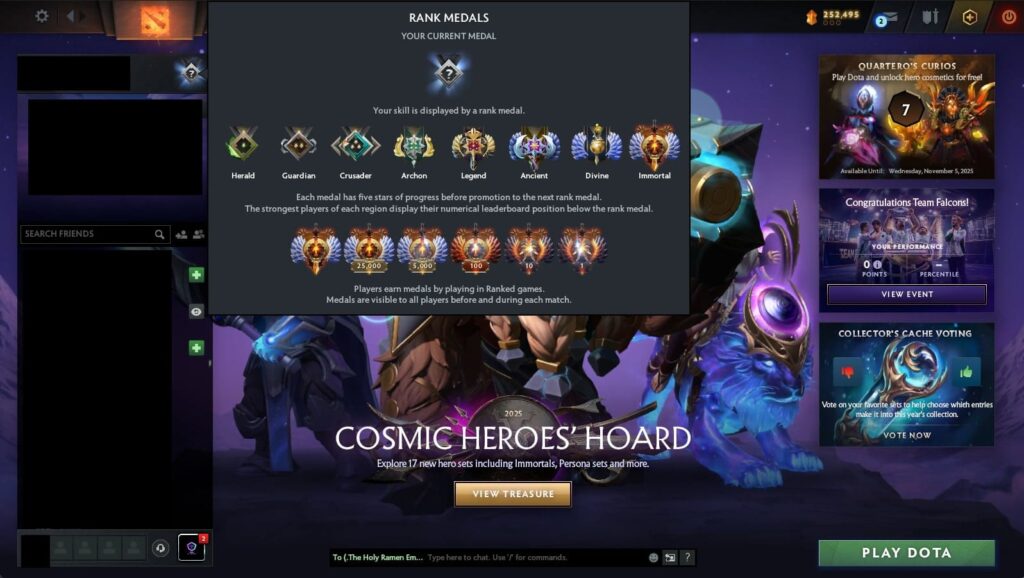
There are eight main ranks in Dota 2, each represented by a medal: Herald, Guardian, Crusader, Archon, Legend, Ancient, and Divine. Above them all is Immortal, which is reserved for the best players in each region (Europe, China, Americas, and SEA).
Every rank medal in Dota 2 except Immortal has five subranks or “tiers,” ranging from 1 (lowest) to 5 (highest). For example, Legend 1 is the entry point to the Legend rank, while Legend 5 is the highest tier before being promoted to Ancient 1. These tiers appear as stars above your medal.
Immortal players don’t have any stars. Instead, they’re placed in regional leaderboards that track the top 25,000 players. For example, an “Immortal 250” player is the 250th highest-rated player in that region. Anyone who’s reached Immortal but isn’t on the leaderboard is Unranked Immortal.
Dota 2 MMR Rank Ranges
This table breaks down the approximate MMR range for every rank and tier in Dota 2.
| Rank | Tier | Approx. MMR Range | |
|---|---|---|---|
| Herald | 1 2 3 3 5 | 0-153 154-307 308-461 462-615 616-769 | 0-769 |
| Guardian | 1 2 3 3 5 | 770-923 924-1077 1078-1231 1232-1385 1386-1539 | 770-1539 |
| Crusader | 1 2 3 3 5 | 1540-1693 1694-1847 1848-2001 2002-2155 2156-2309 | 1540-2309 |
| Archon | 1 2 3 3 5 | 2310-2463 2464-2617 2618-2771 2772-2925 2926-3079 | 2310-3079 |
| Legend | 1 2 3 3 5 | 3080-3233 3234-3387 3388-3541 3542-3695 3696-3849 | 3080-3849 |
| Ancient | 1 2 3 3 5 | 3850-4003 4004-4157 4158-4311 4312-4465 4466-4619 | 3850-4619 |
| Divine | 1 2 3 3 5 | 4620-4819 4820-5019 5020-5219 5220-5419 5420+ | 4620-5420 |
| Immortal | – | Regional Leaderboards | |
How Does The Dota 2 Ranking System Work In 2025?
After the New Frontiers update (Patch 7.33), Dota 2 matchmaking replaced its old Elo-based system, which heavily focused on match outcomes, with a Glicko-based model that also considers Rank Confidence to determine your current skill level.
Here’s a rough idea of how it works:
Rank Confidence
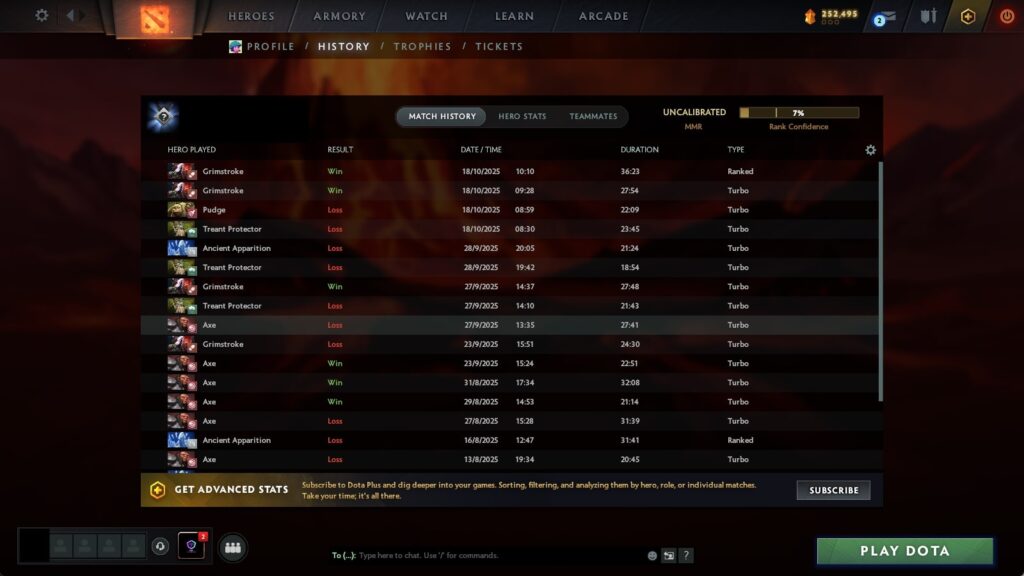
When you start out (or haven’t played for a while), your Rank Confidence will be low. This triggers a kind of “calibration” phase, where the Dota 2 matchmaking system will pair you with a broader range of opponents and apply more dramatic MMR swings after each match.
As you play more ranked games, your Rank Confidence will steadily increase. That signals to you that the system “trusts” its assessment, leading to smaller and more consistent MMR adjustments (usually ±25 MMR) that more closely reflect your actual skill level.
Calibration
Your Dota 2 rank medal only appears once your Rank Confidence reaches 30% or greater, which means the system needs a baseline level of certainty before publicly displaying your tier. Because of that, queuing steadily and sticking to your main roles can help settle your real skill faster.
You can sometimes tell where you stand during this calibration window. If your MMR changes are small despite winning often, your rank is likely higher than your current placement. Conversely, if you’re losing and still seeing large MMR shifts, the system probably hasn’t stabilized yet.
How To Check Your MMR In Dota 2
You can view your MMR in Dota 2 directly from within the game client. Your rank medal is displayed alongside your profile image on the home page and in the top-left corner of your match history page. Your MMR is also visible here, right next to your Rank Confidence.
If you’re an Immortal-ranked player in Dota 2, your name and rank will also show up on the World Leaderboards for your division. These rankings are updated hourly, providing the authoritative snapshot for the top-tier ranks.
If you want to check the MMR of other players, many third-party sites like OpenDota and DotaBuff use the Steam Web API data to provide a rank estimate.
How Is MMR Calculated In Dota 2?
Dota 2’s ranked matchmaking runs on a modified version of Glicko-2. This system tracks three key values: Rating (R), Rating Deviation (RD), and Volatility.
Each match updates the Rating based on your expected win probability and the system’s current certainty. If you’ve been inactive, your Rating Deviation increases, meaning your next few results will have a stronger impact until the system “relearns” your level. Once that stabilizes, your MMR gains and losses even out.
How To Calculate MMR Changes In Dota 2
While Valve hasn’t disclosed the exact method for calculating MMR changes in Dota 2, you can use this intuitive formula to understand the logic:
ΔMMR = f(RD) × (Result − ExpectedOutcome)
- ΔMMR — how much your rating changes after the match.
- Result — 1 for a win, 0 for a loss
- ExpectedOutcome — Glicko’s pre-match win chance (e.g., 0.55 if you’re a 55% favorite)
- f(RD) — a scaling factor based on Rating Deviation.
The closer your ExpectedOutcome is to the actual Result, the smaller your rating will change. This means big upsets (i.e., winning when you’re not expected to) yield far larger MMR gains. By playing matches regularly, you can lower your Rating Deviation, reducing your MMR gains/losses per match.
Immortal Draft & High-MMR Changes
Since March 2025, Dota 2’s Immortal Draft is only triggered if a player in the lobby has more than 8,500 MMR (up from 6,500). To protect that tier, matches with an average MMR greater than 8,500 are now hidden from public history, and replays are private.
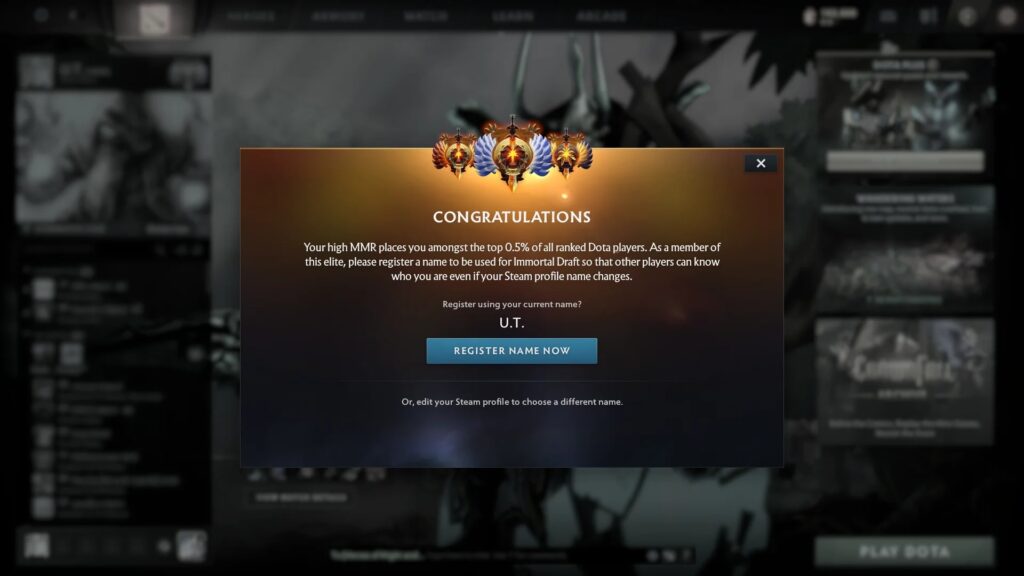
At that level, you must also register an “official name” to play ranked Immortal Draft (this name is used to identify you on the regional leaderboard). You also can’t queue for ranked in a party. Valve has also tuned MMR gains in these games to give more weight to draft outcomes.
Dota 2 Rank Distribution (2025)
Recent snapshots indicate that the middle of the ranked ladder is clustered around Dota’s Crusader and Archon ranks (roughly 40% of all players). However, Immortal remains a tiny fraction of the entire Dota 2 player base at around 3-4%.
Here are the latest rank and tier distribution statistics of today’s overall Dota 2 ranked ladder.
| Rank | Tier | Number of Players | Percentage | |
|---|---|---|---|---|
| Herald | 1 2 3 4 5 | 4,735 83,479 94,834 119,667 155,324 | 0.08% 1.39% 1.59% 1.99% 2.29% | 7.34% |
| Guardian | 1 2 3 4 5 | 155,324 169,632 185,764 198,707 212,220 | 2.59% 2.87% 3.10% 3.31% 3.54% | 15.41% |
| Crusader | 1 2 3 4 5 | 230,791 239,791 247,810 253,580 255,744 | 3.85% 4.0% 4.13% 4.23% 4.26% | 20.47% |
| Archon | 1 2 3 4 5 | 264,509 258,448 252,138 242,119 231,327 | 4.41% 4.31% 4.20% 4.04% 3.86% | 20.82% |
| Legend | 1 2 3 4 5 | 231,839 210,670 192,301 175,476 160,935 | 3.86% 3.51% 3.21% 2.92% 2.68% | 16.18% |
| Ancient | 1 2 3 4 5 | 158,153 136,380 117,572 100,934 90,692 | 2.64% 2.27% 1.96% 1.68% 1.51% | 10.06% |
| Divine | 1 2 3 4 5 | 104,953 88,397 71,224 56,943 53,471 | 1.75% 1.47% 1.19% 0.95% 0.89% | 6.25% |
| Immortal | – | 232,762 | 3.87% | |
| Total | ~6,000,000 | 100.0% | ||
This data is courtesy of OpenDota and is accurate as of October 23, 2025.
How To Rank Up Fast In Dota 2 (MMR Climbing Tips)
Climbing the ranks in Dota 2 is all about stacking small advantages. Focus on mastering a tight pool of heroes, nailing ability and item timings, building strong map awareness, and practicing efficient farming habits. If your plan is clear, your MMR will reflect that discipline.
Early Ranks: Herald To Crusader
The fundamentals are what carry in low MMR Dota 2. Focus on last-hitting, lane control, and avoiding unnecessary deaths—if you do that, you’ll stand out in these ranks. While you’re at it, try to master two or three heroes with simple power spikes (check out our list of the best Dota 2 heroes to climb with).
Buy small items on time, contest runes, stack and pull camps correctly, and call resets after losing trades to stop the bleeding.
Mid Ranks: Archon To Legend
Teamwork and map awareness define this rank bracket in Dota 2. To succeed and escape the trenches, you’ll want to hone your communication skills. This means calling for TP rotations, stacking camps on time (if you’re a support player), and trading objectives immediately after picks.
This includes converting kills into towers or Roshan instead of chasing down more enemies into their base or fountain after a pickoff.
High Ranks: Ancient To Divine
To reach the high Dota ranks, you need a blend of discipline, adaptability, and precision. In this bracket, it’s all about maintaining map control, reading power spikes, staying emotionally composed, and capitalizing on the enemy team’s mistakes.
You’ll also want to review your gameplay, preferably with a coach, to learn from your mistakes and steadily improve as you rank up.
Evolution Of The Dota 2 Ranking System
Since ranking up is one of the core pillars of competitive play, it’s only natural for the system to need constant tuning. Over the years, Dota 2 has changed how it determines your rank, adjusting the system multiple times.
Here’s a quick overview of how Dota 2 ranked matchmaking has changed over the years.
- 2013: Ranked matchmaking was introduced with visible MMR, establishing Dota 2’s competitive foundation.
- 2017: Seasonal rank medals replaced static MMR display, adding progression and resets.
- 2023: Patch 7.33 adopted a modern Glicko-based rating system for more accurate matchmaking.
- 2025: Immortal Draft threshold raised to 8,500+ MMR; high-tier matches and replays became private.
FAQs
What’s the difference between rank and MMR in Dota 2?
Your rank medal in Dota 2 represents your visible rank, while MMR is the rating that determines matchmaking. It essentially decides who you play against—your medal is the “badge” that publicly reflects that.
How many ranks are there in Dota 2?
There are currently eight ranks with five stars each in Dota 2 (except Immortal, which has its own regional leaderboard). This means that Dota 2’s ranked system has 36 progression steps in total, ranging from Herald to Immortal.
What is the highest rank in Dota 2?
The highest rank in Dota 2 is Immortal. It’s tied to regional leaderboards, so the MMR required fluctuates depending on the current player pool.
How does Rank Confidence affect my MMR?
Since Patch 7.33, the size of MMR gains and losses scales with your Rank Confidence. The higher the confidence rating, the smaller the swings will be.
Can you reset or recalibrate MMR in Dota 2?
Yes. If eligible, you can use Active Recalibration in the settings menu. After enabling it, play until your Rank Confidence stabilizes to finalize your new rating.
References
- World Leaderboards (Dota2)
- Rank Tiers (OpenDota)