What Is KAST In VALORANT? Meaning, Calculation & Scores Explained

An important measurement of consistency across a VALORANT map or match is a player’s Kill, Assist, Survive, Trade (KAST) percentage score. While we agree that stats can appear complicated at first, it’s not as scary as you might think—at least not once you’ve got a firm understanding.
In this guide, we’ll explain exactly what KAST is in VALORANT, including what it is, how it’s calculated, a good score to aim for, and tips to improve your performance.

- 1. What Does KAST Mean In VALORANT?
- What Each K/A/S/T Component Actually Measures
- 2. How Is KAST Calculated In VALORANT?
- VALORANT KAST Examples
- What Does 100% KAST Mean?
- 3. What Is A Good KAST Score In VALORANT?
- 4. KAST vs. ACS vs. KDA vs. ADR — What’s The Difference?
- 5. How To Improve Your KAST Score In VALORANT
- Communicate
- Practical Utility Usage
- Stay Alive
- Swing Together
- Crosshair Placement
- 6. Why Your KAST Might Be Low (Even With High KDA)
- 7. Where To Find Your KAST Stats In VALORANT
- 8. VALORANT KAST 2.0 & aKAST Explained
- 9. FAQs
- 10. References
What Does KAST Mean In VALORANT?
KAST is a performance metric that quantifies the number of rounds a player contributed to the team’s success. The acronym stands for Kill, Assist, Survive, Trade, and is displayed as a percentage to show the share of rounds in which a player made one or more of these contributions.
It’s a simple metric that initially appeared on third-party websites during the Counter-Strike: Global Offensive (CS:GO) era. Today, KAST is a key performance indicator, particularly after HLTV began using it in their Rating 2.0 update on June 6, 2027, alongside Average Damage per Round (ADR).
The meaning of KAST in VALORANT boils down to an incontrovertible understanding of how each component is scored.
What Each K/A/S/T Component Actually Measures
To fully grasp what KAST means in VALORANT, let’s discuss every component separately, with examples and caveats, where applicable.
- Kill – The most self-explanatory of the KAST components, simply indicating if you’ve scored a kill on an enemy during a round.
- Assist – Dealing damage to an opponent that gets killed by someone else nets you an assist. Assists are scored for non-damage dealing help as well, like healing a teammate before they get a kill, using nearly any ability that impacts enemies or your allies (e.g., Brimstone’s Stim Beacon, or even if enemies are affected by Skye’s Smoke).
- Survive – If you don’t get a kill or assist in a round, you can still up your KAST% by surviving until the timer reaches zero. Saving your equipment for the next round when you know it’s impossible to win (e.g., a 5v1 situation with the enemy Spike planted) might help your team win the next round.
- Trade – If an enemy kills you, and one of your teammates kills that specific enemy within three to four seconds, you are effectively “traded.” You don’t have to deal damage or even throw out one ability for the trade component to register.
To see how KAST is presented on third-party websites, you can view the top 10 players from VALORANT Champions Paris 2025 in the image below.

How Is KAST Calculated In VALORANT?
You don’t need to be a math wiz or channel your inner Killjoy (genius inventor in the lore) to understand how KAST is calculated in VALORANT. The formula to calculate a player’s KAST% is:
KAST% = (Rounds with kill/assist/survive/trade ÷ Total Rounds) × 100
VALORANT KAST Examples
The following example illustrates how a six-round scenario might unfold.
- Round 1 – You get killed without scoring a kill or assist, and you are not traded. (+0)
- Round 2 – You kill two enemies. (+1)
- Round 3 – You die first, but your teammate eliminates your killer two seconds after you die, which means you are traded. (+1)
- Round 4 – You are on the other side of the map while your teammates kill all enemies. Therefore, you survive the round. (+1)
- Round 5 – You get killed first without scoring a kill or assist. Your teammate eliminates the enemy that took you down seven seconds later. (+0)
- Round 6 – As Cypher, you throw down a Trapwire. You get eliminated from the round without scoring a kill or getting traded. However, an enemy gets stunned by your Trapwire, and a teammate takes them out, which means you’ve scored an assist. (+1)
In the example above, your KAST would be 67%, calculated as (4 ÷ 6) × 100.
The caveat is that meeting multiple requirements in a single round still only counts as one round in the formula. Let’s use a two-round scenario as an example:
- Round 1 – You score two kills, find an assist, and survive the round.
- Round 2 – An enemy kills you before you could score a kill or assist, and a teammate doesn’t kill that enemy in the next four seconds.
In this scenario, your KAST is 50% because you met the requirements in Round 1 but not in Round 2. The formula applies to individual maps and matches with any number of maps, which is why you’ll often see KAST% at events with best-of-three matches and best-of-five Grand Finals.
What Does 100% KAST Mean?
100% KAST means that a VALORANT player has met one or more of the four requirements (kill, assist, survive, trade) in all rounds of a map or match, depending on what you are measuring.
For example, on a map where 18 rounds are played, with Team A winning 13–5, a player with 100% KAST would have met the requirements in all 18 rounds.
We hate to crush those dreams, but scoring 100% KAST on a map is highly unlikely in competitive ranked play or esports tournaments. In a best-of-three match that goes the distance, 100% KAST is simply unheard of (at least in this reality!).
That said, it certainly is possible to achieve 100% KAST on a map, especially as a Sentinel or Controller player who earns a lot of assists. However, the map will have to be very one-sided (13–0 to 13–3) for this achievement—and Lady Luck will have to be on your side.
What Is A Good KAST Score In VALORANT?
A good average KAST is above 65%, and a KAST of 75%-85% indicates star player performance. We’ve outlined a good KAST% for the four roles in VALORANT below.
- Duelist – 55 to 65%
- Initiator – 58 to 67%
- Sentinel – 68 to 73%
- Controller – 69 to 74%
Please note: The information above should be considered estimates, based on pro statistics. For the average competitive player in Premier mode, reducing the KAST values above by 5% is still considered a good result.
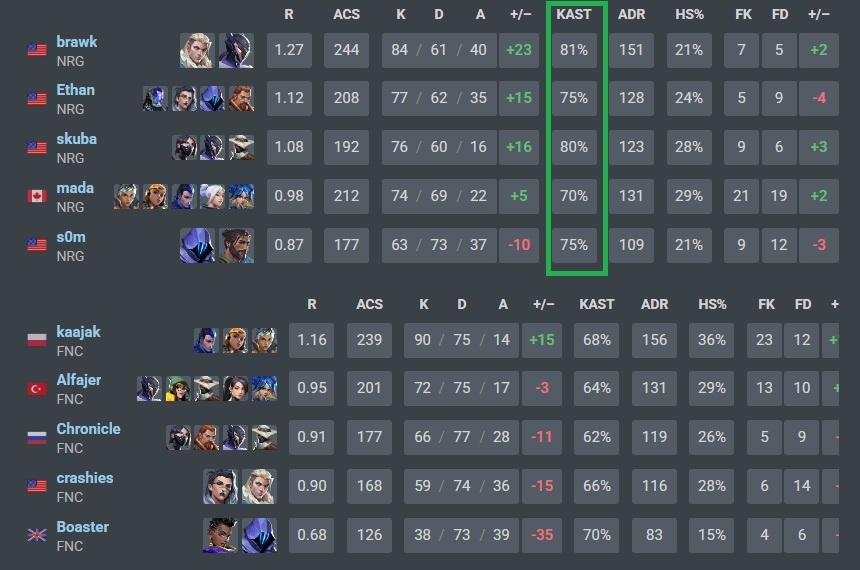
The example below shows NRG and FNATIC’s stats from the VALORANT Champions Paris 2025 Grand Final.
Notice how Brock “brawk” Somerhalder had the best KAST at 81%, earning himself the MVP of the tournament, while Controller Logan “skuba” Jenkins was in second place, and Duelist Adam “mada” Pampuch had the lowest KAST of the team.
KAST vs. ACS vs. KDA vs. ADR — What’s The Difference?
There are many stats in VALORANT, and KAST is just one of them. Other key performance indicators include ACS, ADR, and KDA. Check out the meaning and short description of each so that you can understand the difference between them.
- ADR – Average Damage per Round indicates damage-dealing prowess over the course of a map or match.
- KDA – The Kills, Deaths, and Assists stat combo indicates a player’s fragging efficiency.
- ACS – Average Combat Score is a holistic overview of a player’s impact on a map or match.
A measurement of player performance should include multiple statistics, including those listed above, and other high-impact factors, such as performance in economy rounds and 1vX clutches.
How To Improve Your KAST Score In VALORANT
Want to know how you can improve your KAST score in VALORANT? No problem! We’ve got you covered with five essential KAST improvement tips.
Communicate
Keep your teammates informed of enemy locations at all times. For example, quickly say “left” and “box” to indicate an enemy shot you from the left-side box callout. If a teammate is close by, your kill could be traded in the timing window, or you could earn an assist.
Practical Utility Usage
Learn the ins and outs of every competitive VALORANT map, so you can most efficiently deploy your Agent’s kit, from AOE damage-dealing abilities to stunning enemies, and buffing teammates. This will help you earn assists.
Stay Alive
The longer you stay alive in a round, the higher your chances of dealing some damage or earning a kill/assist. Remember, you complete a KAST requirement (i.e., the S for survive) simply by surviving the entire round. Just don’t overdo it and go hiding in a corner while your team fights for survival—nobody likes a camper.
Swing Together
Stick close to your teammates and swing around a corner at the same time, drawing enemy fire. After all, an enemy cannot headshot both of you at the same time if you are coming from different angles, allowing you to either get a kill, assist, or get traded if you are the primary target.
Crosshair Placement
Practice your pre-aiming stances and positioning on every map to improve your accuracy. A good crosshair placement where an enemy’s head is likely to appear could result in more rounds where you score a kill or assist, effectively upping your KAST%.
Above all else, don’t let your hunger for improving your KAST score negatively impact your team’s chances of winning.
Why Your KAST Might Be Low (Even With High KDA)
Your KAST% could be low (under 50%) despite scoring a high number of kills in a match. A low KAST with high kills indicates a map where a player is “hot” and “cold,” with performance fluctuating widely.
For example, scoring four kills and one assist in Round 1, and zero in Round 2, while dying in both, gives you a solid KDA of 4-1-2, but a KAST of only 50%.
A low KAST and high kill count further indicate inefficient kill-trading tactics by the team.
Where To Find Your KAST Stats In VALORANT
The in-game match report and scoreboard do not show KAST. However, gamers can use third-party platforms to see their KAST.
If you want to view your KAST, you can use your Riot ID to sign in to a third-party website, such as Tracker.gg, and navigate to the VALORANT section. Sync your account following the platform’s instructions.
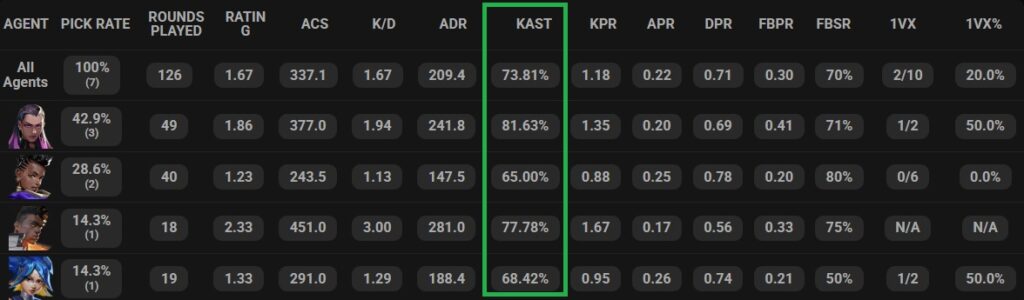
Once you’re logged in, you can go to your profile and click on “Overview” to find a range of valuable stats, including KAST. The example below showcases the stats of one of the top players registered on the Tracker.gg platform.
Warning: Use third-party websites at your own risk. ENET is not responsible for any issues that may arise from logging in to or syncing your Riot ID with third-party websites.
VALORANT KAST 2.0 & aKAST Explained
Some analysts use new or experimental versions of the KAST stat. After all, the metric on its own has limitations. For example, multikills or 1vX clutches have no impact on KAST%.
- KAST 2.0 – Recognizes that players sometimes earn more than one requirement of KAST in a single round, such as scoring a kill, two assists, and either getting traded or surviving. KAST 2.0 aims to evaluate the total number of successful events and accounts for multikills.
- aKAST – Combining KAST and KAST 2.0, aKAST includes the player’s overall impact in rounds, all their contributions, and consistency throughout a map or match.
FAQs
How Is KAST Calculated In VALORANT?
The mathematical formula to calculate KAST in VALORANT is: (Rounds with kill/assist/survive/trade ÷ Total Rounds) × 100.
What Does KAST Stand For In VALORANT?
KAST stands for Kill, Assist, Survive, Trade. A percentage sign follows the stat and indicates the percentage of rounds in a map or match that a player met one or more of the four conditions.
What Is A Good KAST Score In VALORANT?
Generally, a KAST score above 65% is considered good, and a score above 75% is considered excellent in VALORANT. It does depend on your role, though, with Controllers and Sentinels typically averaging higher than Duelists and Initiators.
What Does 100% KAST Mean In VALORANT?
100% KAST means a player met one or more of the conditions in every round played.
How Can I Improve My KAST Percentage In VALORANT?
The easiest way to improve your KAST% in VALORANT is to hone your teamwork prowess. Jump in to help teammates, and use your Agent’s abilities consistently, for a higher chance at scoring kills and assists.
References
- Valorant Stats (Tracker.gg)